January 2022 Newsletter
|
|

Happy New Year!
In mid-November CMS released their final 2022 Physician Fee Schedule in full. The UMTRC is dedicated to answering your questions on the new Physician Fee Schedule during or after our open question and answer sessions in our Virtual Office Hours. Additionally, this blog highlights some of the frequently asked questions related to how the new PFS impacts telehealth. Check out the blog post here and feel free to email us with your questions!
During the month of January, our podcast “A Virtual View” will start dropping episodes again on the third Friday of the months and will resume its regular schedule (1st and 3rd Friday of every month). If you haven’t listened to our latest podcast please listen to it here.
|
|
Call for Speakers
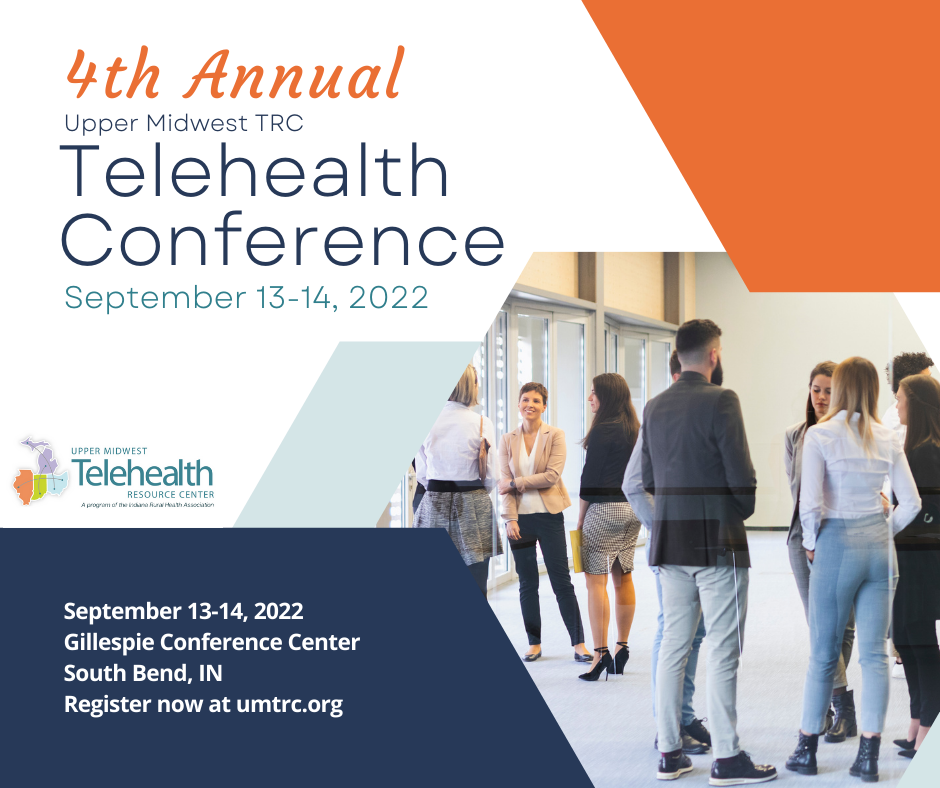
The UMTRC staff are excited to announce that the 4th UMTRC Annual Conference will be back in South Bend, Indiana on September 13-14, 2022, at the Gillespie Conference Center. We have opened the call for speakers to present at the conference. If you are interested in participating in the 2022 UMTRC Annual Conference as a concurrent session presenter, please submit the application below by March 31, 2022.
We look forward to being able to see many of you in person again this year!
The UMTRC staff will be opening registrations for exhibitors and attendees early in 2022.
To be sure you don't miss important updates about the conference, join our mailing list!
|
|
Upcoming Webinars
The UMTRC partners have several webinars planned for the month. We hope that you can join them and welcome your requests for additional topics for future webinars.

IRHA Lunch & Learn: Telehealth Beyond Telestroke
Date: January 19, 2022
Time: 10:00am - 11:00am Eastern
Presenter(s): Meena Mallipeddi, CEO, T SQRD, Anand Nathan, COO, T SQRD
Objectives:
1. Understand the various negative medical and financial impacts of not offering key non-procedure based specialties locally
2. Understand the recent reimbursement changes in Medicare and other Payors' telemedicine coverage and what that means for hospitals’ physician coverage options
3. Understand the options available for specialty teleconsults, beyond the standard telestroke model, and the benefits unique to each
4. Understand what medical and financial benefits hospitals that have implemented remote specialty coverage have seen, and the related best practice takeaways
Register HERE
|
|

"Artificial Intelligence in Virtual Care"
Date: January 19, 2022
Time: 12:00pm-1:00pm Eastern
Presenter(s): Jessica Devine, Program Coordinator for the UMTRC
The term artificial intelligence is increasingly heard in many areas of life and especially in healthcare. This webinar will begin by explaining artificial intelligence to make it an accessible concept and not seem like a far-off science fiction topic. The webinar will progress to speak about current uses of artificial intelligence as well as introduce future directions of utilization in virtual care. Come join us for this discussion about powerful technology.
Register HERE.
|
|

IRHA Lunch & Learn: Improving Care for Vulnerable Populations in Indiana with Asynchronous Telehealth
Date: January 20, 2022
Time: 12:00pm - 1:00pm Eastern
Presenter(s): Daren Anderson, MD, President/Founder of ConferMED
Register HERE
|
|

"Common Substance Use Disorder Coding and Reimbursement Practices"
Date: February 9, 2022
Time: 12:00pm-1:00pm Eastern
Presenter(s): Micah Kassahun, Data Coordinator for the Crossroads Partnership for Telehealth and the Indiana Rural Opioid Consortium programs at IRHA.
The content of this webinar is aimed at rural healthcare providers and institutions with the intention of establishing foundational SUD coding and reimbursement practices. Elements of ICD-10, CPT, and HCPCS coding practices will be introduced and discussed throughout the presentation.
Register HERE
|
|
Virtual Office Hours

Similar to webinars, our Virtual Office Hours are offered virtually. They are more informal, more interactive, and typically only last 30 minutes, instead of an hour.
Our January Virtual Office Hours will be an open Q&A session.
Bring a beverage and your questions. We've got answers!
January 20th (1:30-2:00 Eastern)
January 25th (2:00-2:30 Eastern)
RSVP on the website!
Upcoming In-Person Conferences & Virtual Events
As state Public Health Emergencies (PHEs) start to sunset throughout the region, there are a mix of virtual and in-person conferences available. As we learn about regional and national conferences, we will post them on our website in the Events section of the UMTRC website.
|
|

TeleICU and Acute Care SIG Webinar
The ATA is hosting a webinar on January 19th at 12:00pm that is focused on TeleICU/Acute Care SIG. This provides a stabilizing influence for organizational concepts and directions to be established and maintained with a visionary view for the TeleICU/Acute Care environment.
Discussion topics may include advancing state and federal reimbursement, collecting and reporting quality metrics to validate improved outcomes, discussing and implementing evidence-based standards, and transparently sharing information with committee members.
You can register here
|
|

You can still register for the IRHA Public Policy Forum
Don't miss important updates on healthcare issues from the state and national perspective! This event will be held virtually on January 27, 2022.
We are excited to have Lindsay Weaver, MD, FACEP, Chief Medical Officer, Indiana Department of Health and Brock Slabach, MPH, FACHE, Chief Operations Officer, National Rural Health association, and many other great speakers joining us!
View the full agenda HERE
Attendee registration is available here: https://www.indianaruralhealth.org/PublicPolicyForum
|
|
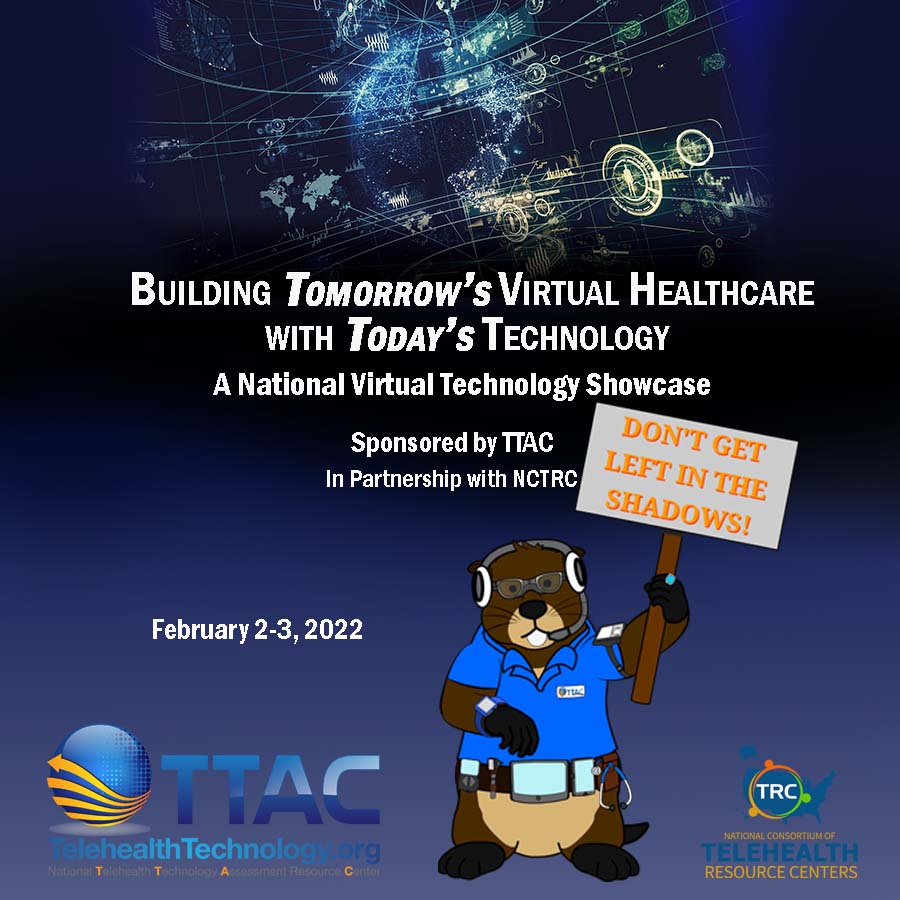
Don’t miss the National Virtual Technology Showcase February 2nd and 3rd!
Register now for Building Tomorrow’s Virtual Healthcare With Today’s Technology: A National Virtual Technology Showcase on February 2-3, 2022. This two-day event will feature several telemedicine use case scenarios where patients, caregivers, and providers present virtual care models such as emergency services, behavioral health, school-based care, remote patient monitoring and direct to consumer patient care.
Attendees will have an opportunity to discuss the various telehealth technologies used in the telemedicine scenarios with the vendors themselves.
Exciting Keynote presenters will kick off each day of the two-day event. You won’t want to miss a discussion with Dr. Meskó (aka “The Medical Futurist”) and other leaders in the industry who are developing and implementing innovative ways of using technology to enhance patient care.
Register here: https://www.airmeet.com/e/537f1540-5878-11ec-8fbf-fbe163bdaf7a
________________________________________________________________________________
UMTRC staff will present during the showcase on the topic of Remote Patient Monitoring!
Remote working, learning and so much more – we are living in a remote world. Don’t miss our remote patient monitoring use case, providing valuable insight into the capabilities of current RMP technology and the value of data management and outcomes.
Register now: https://www.airmeet.com/e/537f1540-5878-11ec-8fbf-fbe163bdaf7a
|
|
Information and Other Resources
HHS/DoD National Emergency Tele-Critical Care Network.
A joint program of the U.S. Department of Health & Human Services (HHS) and the U.S. Department of Defense (DoD) is available at no cost to hospitals caring for COVID-19 patients and struggling with access to enough critical care physicians, nurses, respiratory therapists, and other specialized clinical experts. Teams of critical care clinicians are available to deliver virtual care through telemedicine platforms, such as an app on a mobile device.
Hear from participating clinicians, and email to learn more and sign up.
______________________________________________________________________________________
Baptist Health uses $873K grant to build out RPM capabilities and expand telehealth
Without the demands of the pandemic, and without financial help from the FCC, the health system would have taken a more conservative approach.
"For far too long, patients needed to follow the hospital's rules to seek care – must drive in, wait in a room, et cetera," said Nick Sarantis, system director of digital health at Baptist Health. "The advancement of digital health helps to put some of the control back into the patients' hands. We have seen this change in every other aspect of life – banking, retail, insurance, entertainment, et cetera – and consumer expectations had been evolving for quite some time."
DIG INTO THIS CASE STUDY
______________________________________________________________________________________
Strategies to work toward equity in healthcare
Telemedicine can be used to expand access to healthcare – but it can also exacerbate the digital divide. Dr. Uché Blackstock, founder and CEO of advancing Health Equity and Yahoo News Medical Contributor, speaks with Kat for HIMSS TV about steps vendors can take to mitigate bias in digital health tools. Watch it here.
How telehealth helps prevent burnout among nurses
In a HIMSS TV Digital Checkup, Bill talks with Laura Jonsson, a nurse practitioner and Matrix Medical Network's chief clinical officer, who shares how telemedicine technology and the different care paradigm it enables help nurses minimize stress and the burnout it can cause.
|
|
Recently Published Articles on Telemedicine and e-Health
Female physicians more likely to adopt telehealth early
A study published in JAMA Network Open found that while the vast majority of physicians in a large regional healthcare system had transitioned to include virtual care in their practice by January 2020, some were more likely to be early adopters.
"Some physicians may have been nimbler than others in making the transition [to telehealth], potentially influencing patients' experience of physician access and availability," wrote the research team.
LEARN MORE ABOUT THIS STUDY
__________________________________________________________________________________________
Analysis of Telehealth Usage and Trends in the Military Health System, 2006–2018
Cathaleen Madsen, Amanda Banaag, and Tracey Pérez Koehlmoos
__________________________________________________________________________________________
Digital Health Care in Public Private Partnership Mode
Krishnan Ganapathy, Santos Das, Sangita Reddy, Vikram Thaploo, Ayesha Nazneen, Akhila Kosuru, and Uday Shankar Nag
______________________________________________________________________________________
Outpatient Virtual Visits and the “Right” Amount of Telehealth Going Forward
Andrew J. Thomson, Christopher B. Chapman, Hannah Lang, Anne N. Sosin, and Kevin M. Curtis
__________________________________________________________________________________________
Impact of Pediatric Electronic Consultations in a Federally Qualified Health Center
Anthony Porto, Karen Rubin, Kristina Wagner, Wei Chang, Giuseppe Macri, and Daren Anderson
|
|
Social and Subscribe
Be sure to connect with the UMTRC on Facebook, LinkedIn, and YouTube for information on where to find us at training sessions, conferences, and the like.
|


UMTRC c/o IRHA
2901 Ohio Boulevard, Suite 240
Terre Haute, IN 47803
855-283-3734 extension 238
[email protected]
This newsletter was made possible by grant number U1UTH42522 from the Office for the Advancement of Telehealth, Health Resources and Services Administration, DHHS.